

What If A Girl Wears A Lot Of Makeup?
F rom the soot-rimmed eyes of the aboriginal Egyptians to the lead pigment worn by the Elizabethans, women and girls have experimented with cosmetics throughout history. Indeed, co-ordinate to the Roman playwright Plautus, "a woman without pigment is like food without salt". Shakespeare's Hamlet was less peachy but just as rude, telling Ophelia: "I've heard all nearly you women and your cosmetics besides. God gives y'all 1 face, but you paint another on top of it. You trip the light fantastic and prance and lisp; you telephone call God'southward creations past pet names, and you alibi your sexpot ploys past pleading ignorance."
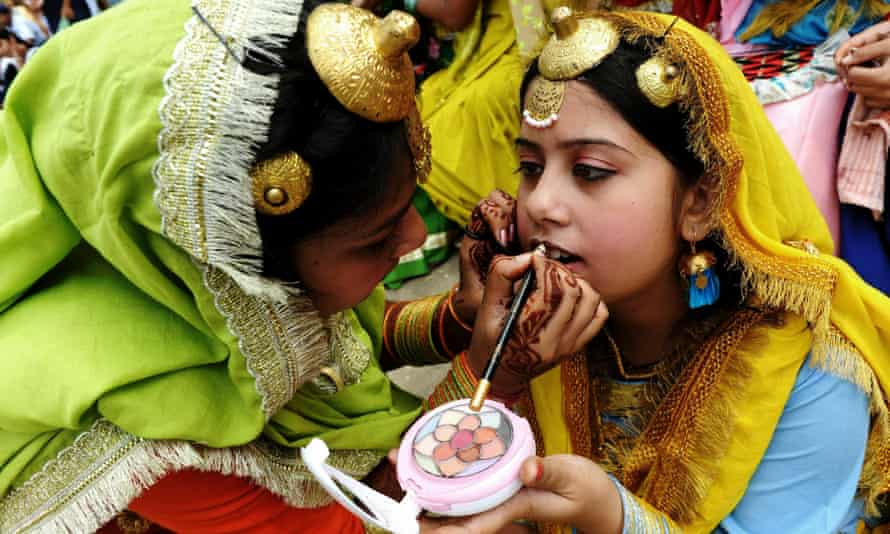
And then is makeup necessary seasoning, a conniving ploy by manipulative sexpots, or neither? Inquire a group of women why they wear makeup and y'all'll receive myriad responses. Some will say it makes them feel more than confident, that they don't experience completely "washed" without information technology; others will say they love experimenting with looks and colours as a way of expressing themselves, that at that place'southward a fun, theatrical element to confront paint that allows them to channel dissimilar personalities and aesthetics.
"Subsequently twenty years working as a makeup artist I can say quite confidently that women wear makeup for themselves," Lisa Eldridge, the writer of Face Pigment: The Story of Makeup, tells me. "There are many different roles makeup tin can play in a adult female's life. There's the playful and creative aspect – who doesn't relish swirling a brush in a palette of color? Then there's the confidence-building attribute – why not cover a huge blood-red blemish on your olfactory organ, if you tin can? Finally, there is an element of war paint and tribalism. Makeup tin can brand you experience more powerful and ready to confront any situation."
Simply just as there are women and girls who wear makeup completely for themselves, there are those who vesture makeup for the perceived benefit of others, or who feel as though they are unacceptable without it. Makeup can be a mask you hide behind that gets you set to face the world, or something you deploy as a weapon – to attract a partner, to intimidate, shock and astonish. It is used every bit part of religious or cultural rituals, or to align yourself with a subculture. It can mask your insecurities or exist used to heighten the bits you love the most.
Makeup is so ubiquitous in our society that for a woman to go without it has become, in some cases, a statement – the "no makeup selfie" being a case in point. Female person celebrities feature on the Daily Mail's sidebar of shame beneath headlines such as "Jennifer Lopez, 46, dares to bare her naked face". Boybands, meanwhile, cynically tap into the anxiety young women feel past challenge that they love you just as you are, a trend expertly satirised in the Amy Schumer sketch "Girl you don't need makeup".
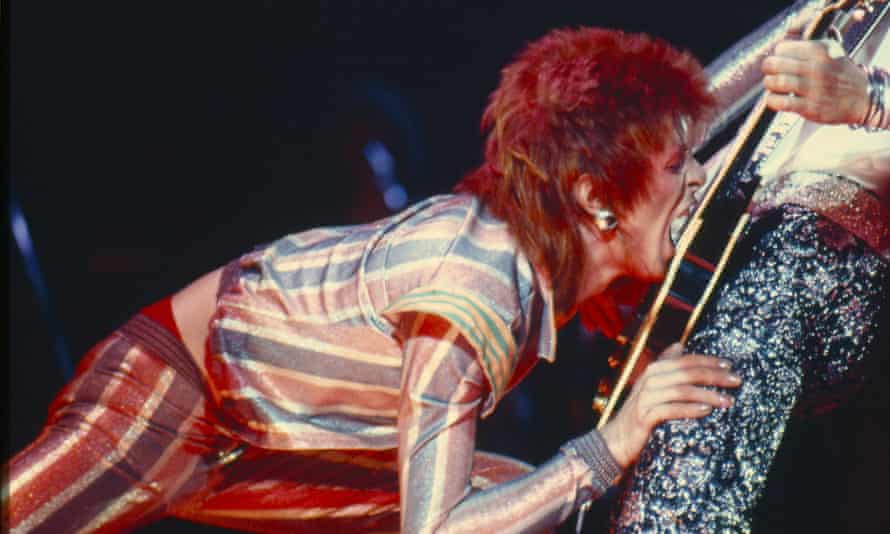
Perhaps, then, the more useful question to ask is non "Why exercise women habiliment makeup?" but "Why do women vesture makeup when about men don't?" (especially when David Bowie's career bears testimony to the fact that the sight of a man in makeup can do powerful things to a adult female'due south nether regions).
For some feminists, the question tin can exist answered by simply muttering "patriarchy" and dusting off their hands before heading to the bar. Certainly, women receive messages from an early age that encourage us to believe that i of our primary functions is to be decorative and therefore appealing to men. Get into whatever newsagent and y'all'll run across footling girls' magazines that come with gratuitous gifts of lipgloss and nail varnish. Parents buy their daughters strange, disembodied dolls' heads to practise on. The Disney princesses and so many piddling girls model themselves on wear eyeliner, mascara and eyeshadow, and have perfectly plucked eyebrows. Considering the extent to which makeup is viewed equally a process of beautification used for alluring a mate, to foist it upon girls so young is arguably more than a little creepy.
Evolutionary psychologists accept information technology that, as with so many things, makeup comes down to sex. Women tend to have darker eyes and lips than men, and makeup enhances those sex activity differences. Furthermore, the desirable qualities a man looks for in a woman – largely related to reproductive fettle – are said to be amplified by makeup. Dazzler ideals vary from civilisation to culture, but there are some universal markers of attractiveness. Facial symmetry and an even skin tone imply practiced wellness, while youthfulness denotes fertility. Plump lips and flushed cheeks, meanwhile, are signs of sexual arousal, so your cerise lipstick and pink blusher might just exist giving that random man in the bar the hidden point that yous're set for a nighttime of passion.
Readers of women'south magazines will be familiar with the use of evolutionary psychology to flog cosmetics. I'll never forget reading an article that suggested I clothing ruddy lipstick so my lips could mimic blood-flushed labia. And, if a vagina oral cavity isn't your affair, and so you lot could always make the pare on your face resemble a babe's in club to attract men, a suggestion repeated with alarming frequency in the pages of the glossies and capitalised upon by makeup make Maybelline'southward Baby Skin range.
Cosmetics companies often rely on women'southward insecurities – inculcated through years of exposure to images of concrete perfection in mainstream media – in order to sell products, operating on the basis of "possibly she's born with it, but probably not, then buy this concealer". Its part equally a means for covering up unwanted flaws or "unsightly" blemishes is hammered into united states of america again and once again. Many women spend hundreds of pounds each yr on cosmetics, and as many minutes worrying about the way we look. In The Dazzler Myth, Naomi Wolf makes a persuasive instance that the beauty industry exists to command a generation of women in the procedure of emancipation. Keep the states anxious, proceed us hungry, keep united states of america always vigilant in our quest for physical perfection, the statement goes, and you keep u.s. down.
As such, the message that your natural dazzler is never enough is socialised into us very young. I first started to wearable makeup as a young teenager because I believed the freckles dusted across my cheeks were ugly. My mother, a redhead who before leaving the firm will say "Hold on, I just need to put my eyelashes on", never encouraged me to wear makeup until – concerned well-nigh the fade-out cream I was using in an try to bleach out my freckles – she thankfully steered me in the management of foundation (and then spent the next 10 years pointing out the slightly orange tidemarks that would launder upwardly around my chin). At the time, covering upward my freckles made me experience better well-nigh myself, more than attractive, more in keeping with the "type" of girl I believed boys went for. It wasn't until I gained confidence, and started seeing more varied portrayals in the mainstream media, including girls with freckles, that I began to wonder if they were really so hideous after all.
When the vision of dazzler you are presented with is largely homogeneous, it's only natural that you might resort to makeup as an attempt to "blend in" or to "pass". But, as oft with trappings of femininity, you're stuck between a rock and a hard identify. Studies repeatedly tell us that men are more attracted to women who wear makeup. We're encouraged to aspire to a kind of unnatural natural dazzler, as captured by the immortal words of Calvin Klein, who said, helpfully: "The best thing is to look natural, but it takes makeup to look natural." (Thanks, Calvin.)
Of class, as the aforementioned Plautus was no doubt unaware, also much table salt – a probable feature of life in ancient Rome due to the absence of refrigeration – tin can be a bad thing. A study concluding twelvemonth at Bangor and Aberdeen universities found that both men and women thought women with some – but non as well much – makeup were almost attractive. According to the report'south abstract, "these findings suggest that attractiveness perceptions with cosmetics are a form of pluralistic ignorance, whereby women tailor their cosmetics preferences to an inaccurate perception of others' preferences." The Atlantic, which reported the findings, was quick to point out that "the judging took identify in Bangor, a tiny hamlet in Wales, where beauty standards are probably dissimilar than they are in Beijing or Berlin or Baton Rouge". (If they were suggesting that those standards might exist lower, well, those of usa who take frequented the ladies' toilets of the Bangor Wetherspoon'southward and seen a makeup session in progress would humbly beg to differ).
Peradventure, then, when it comes to makeup, we are our own worst enemies, believing that the world wants to see usa in a sure way when in actual fact we're fine the style we are. Why do women wear makeup? You lot could say it'south a pinch of patriarchy, a dusting of sex activity, a smattering of fun, and a whole, caked-on layer of misplaced insecurity.
Source: https://www.theguardian.com/commentisfree/2015/oct/21/why-do-girls-wear-makeup-google-answer
Posted by: woodtimstrance1982.blogspot.com
0 Response to "What If A Girl Wears A Lot Of Makeup?"
Post a Comment